Five practical strategies for coordinating curtain wall glazing—from delivery logistics to anchor tolerances. By Chuck Knickerbocker
Five Strategies to Improve Curtainwall Glazing Efficiency on Complex Projects
xxxxx. xxx
xxxxx
xxxxxxxxx
xxxxxxxxxxxxxxx By xxxxxxxx
h2 - xxxx
h3 - xxxx
H1 headline
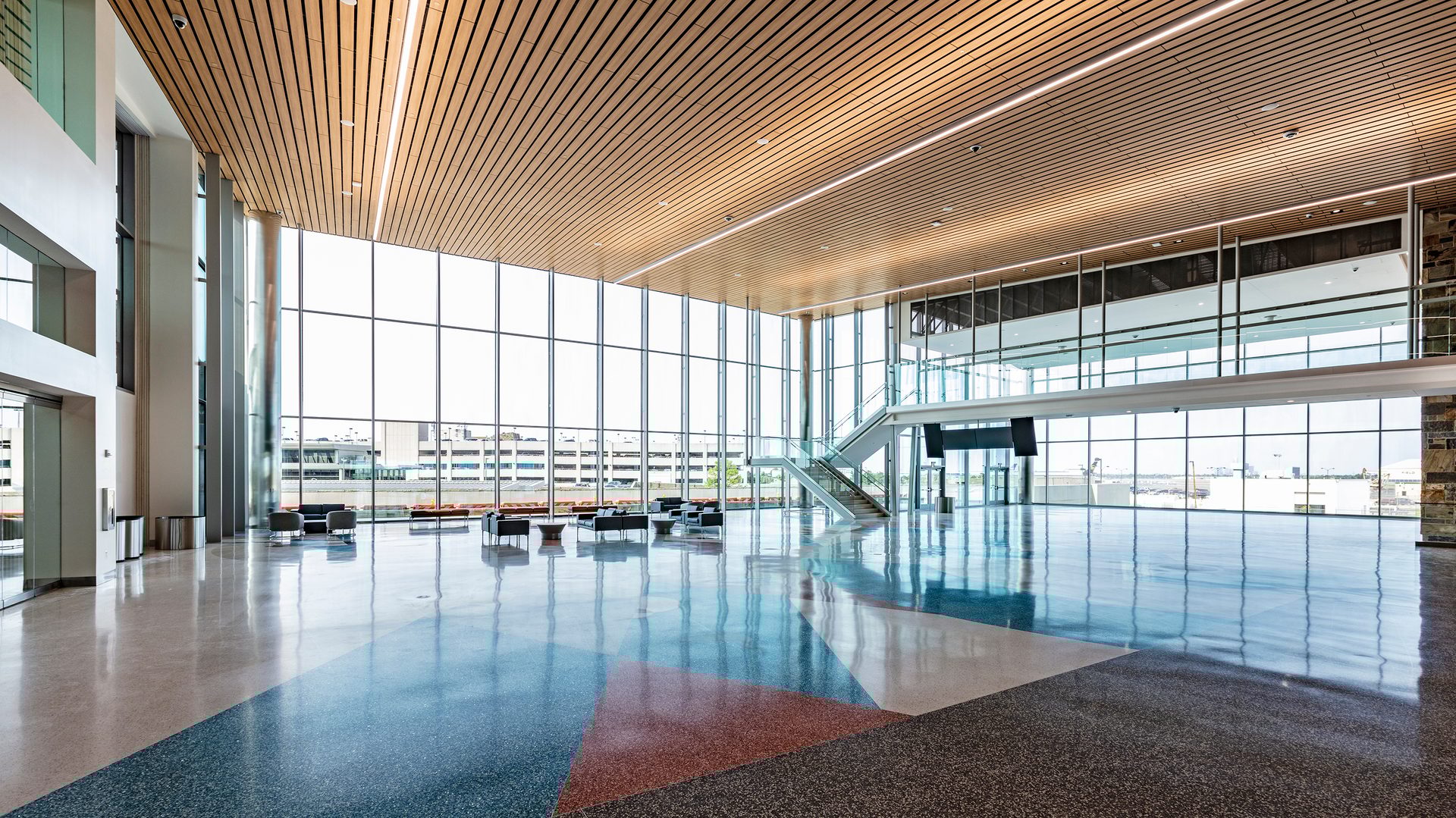
Oklahoma City’s Will Rogers World Airport includes a segmented exterior glass curtain wall representing some of the largest glazing work installed by Avenue C Glass, the contract glazier. Mike Marlin, project manager at Avenue C Glass, explains, “The bow, stainless-steel frames and large spans—all of it was a leap forward for us.”
By taking a coordinated and collaborative approach, Avenue C Glass ensured the glazing systems were planned and installed according to the design intent. The result demonstrates both the scale of the curtain wall and the intricacy of its installation.
For project teams, understanding logistics, anchoring and sealing protocols—and the processes behind complex glazing assemblies—can improve installation efficiency and project outcomes. The following tips provide a starting point for improving jobsite coordination and installation of complex glazing systems.
1. Strategize for Feasible Delivery Schedules
Delivery timelines are critical to ensuring curtain wall projects proceed smoothly. Proper planning can also help glazing subcontractors streamline installation while reducing glass damage and jobsite congestion.
Whether a project uses prefabricated curtain wall units or field-assembled systems, the site must provide adequate laydown space and access for equipment required to place curtain wall components. Both assembly types therefore require coordination with other trades and construction phases to maintain workable site conditions.
Manufacturer lead times also influence scheduling. Collaborating with a trusted manufacturer can help project teams establish realistic timelines.
Ideally, glazing subcontractors coordinate with general contractors during the proposal phase to outline installation requirements. After contract award, teams can finalize material delivery and installation schedules. This approach reduces the risk of damaged components and simplifies jobsite logistics, allowing the general contractor to plan concurrent work and manage the return of floor space for other trades.
xxxxxxxxxxxx
2. Mind Anchors and Sealants
Understanding permissible anchoring systems is critical because anchors connect the curtain wall assembly to the building structure. Simplifying anchor design wherever possible can significantly reduce field installation costs, although feasibility depends on the specific assembly and structural interface.
Most anchors are designed with adjustability to accommodate installation tolerances. Specifications commonly allow approximately 1 inch of adjustment in all directions—in/out, left/right and up/down—from nominal position.
Stick-built systems typically use simpler anchoring methods, often consisting of anchor clips attached to vertical mullions and connected to embeds or welded structural elements. Contractors should verify anchoring systems and allowable tolerances with both manufacturers and engineering teams before installation begins.
Project teams should also clarify responsibility when anchor conditions fall outside allowable tolerances. Additional engineering and fabrication may be required to design modified anchor components to accommodate “as-built” conditions. Depending on the situation, these changes can exceed $2,000 and add about a week to the schedule—highlighting the importance of constructing the structure within the specified ±1-inch tolerance.
Sealants are equally critical to glazing performance. Assemblies must be installed according to manufacturer product literature, including ensuring clean, dry substrates and verifying that weather conditions allow proper curing.
Sealants typically maintain the air- and water-resistance lines between the glazing system and adjacent construction. They also accommodate movement caused by wind loads, thermal expansion and contraction, and structural deflection.
Undersized joints can lead to leaks, while oversized joints increase installation time and material use. Installation manuals include detailed instructions for internal sealing, gasket placement, compartmentalizing glazing pockets, sealing pressure plates and directing water paths to the exterior. Installing a system without following these requirements—or correcting sealant work contrary to manufacturer instructions—may void the manufacturer’s warranty.

xxxxxxxxxxxx
3. Understand Requirements for Fire- and Security-Rated Glazing
Specialty glazing assemblies—including fire-rated and security-rated systems—require additional attention during installation to ensure performance in emergency conditions.
Improper installation of fire-rated glazing can create life-safety risks and may prevent a building from receiving a certificate of occupancy, delaying project completion and increasing costs.
Glazing subcontractors should verify that all components share compatible ratings. A fire-rated glazing assembly can only perform to the level of its least protective component. This includes glass lites, framing members, anchors and their attachment points, door frames and hardware.
Context within the building is also important. For example, two assemblies may both carry 60-minute fire ratings but one may serve as a fire barrier while the other functions as a fire partition. Each system is anchored differently based on its tested configuration, and components generally cannot be substituted between systems without engineering review.
Fire-rated and security-rated glass products are also heavier than standard glazing, requiring stronger framing systems or closer mullion spacing to maintain structural performance.
xxxxxxxxxxxx
4. Consider the Entire Planning and Construction Process
Field conditions rarely match project models exactly. Variations in concrete, framing or structural dimensions can introduce challenges that affect glazing installation.
For example, long runs of floor-to-ceiling glazing may experience significant installation difficulties if small variations occur in slab elevations. Even minor deviations can compound across large spans.
When these issues arise, field teams must troubleshoot quickly to avoid schedule impacts. Efficient problem-solving helps prevent delays that can ripple through punch list completion and project turnover.
Involving manufacturers early in the planning and construction process can help project teams anticipate potential issues. Manufacturer technical teams understand the limits of their assemblies and often have experience with similar installations.
Their insight can help design teams refine system details while supporting field crews in resolving jobsite challenges. Early collaboration also helps ensure ambitious architectural designs remain achievable within real-world construction constraints.
5. Collaborate to Find Efficiencies
Collaboration typically begins when the architect and general contractor engage a glazing subcontractor to help execute the design within budget. This process often takes the form of design assist, which involves coordination among architects, contractors, manufacturers and installation crews.
Early involvement of field crews and manufacturer engineering teams allows projects to identify design and fabrication efficiencies before construction begins. Nearly every aspect of a glazing project—from fabrication to installation sequencing—can potentially be improved through collaborative planning.
For custom projects in particular, efficiencies often emerge through dialogue among teams. Installation crews may identify practical improvements that influence estimating, procurement or fabrication decisions.
Glazing subcontractors ultimately connect design and engineering teams with building occupants and end users. Successfully executing complex façade systems not only supports architectural ambitions but can also expand the capabilities of glazing crews and contractors.
Reflecting on the work at Will Rogers World Airport, Marlin emphasizes that sense of accomplishment: “The scale of these systems is impressive. It’s some of the biggest glazing work we’ve done. The curtain walls were satisfying to install.”
Images courtesy of Technical Glass Products.
Chuck Knickerbocker is the curtainwall manager for Technical Glass Products, a supplier of fire-rated glass and framing systems, along with specialty architectural glazing products. With over 44 years of curtainwall experience, Chuck has successfully worked with numerous architects, building owners and subcontractors from development of schematic design through installation.