A clear, practical guide to the key differences between open- and closed-cell spray foam insulation—and how to choose the right option based on performance needs, climate, and building goals. By Maxime Duzyk
Choosing Between
Open and Closed Cell Spray Foam Insulation
xxxxx. xxx
xxxxx
xxxxxxxxx
xxxxxxxxxxxxxxx By xxxxxxxx
h2 - xxxx
h3 - xxxx
H1 headline
Spray polyurethane foam insulation has gained immense popularity over the past several decades. Its application in commercial buildings—whether industrial, agricultural, institutional, office, multifamily, retail or mixed-use—has grown alongside increasingly stringent building codes, the move toward sustainable and healthful structures, and the need to fortify buildings against inclement weather and storm damage. It has also been chosen in large part for its ability to dramatically reduce heating and cooling energy demands, as well as energy costs.
All spray foam insulation must be professionally installed. A certified installer provides added peace-of-mind the material will be installed safely, correctly and for the material’s optimized performance. During installation, the spray foam adheres to the substrate, expands in place at the application site, and seals the building envelope. It also holds its shape over time, which ensures long-term R-value performance - a benefit that other insulations can’t deliver.
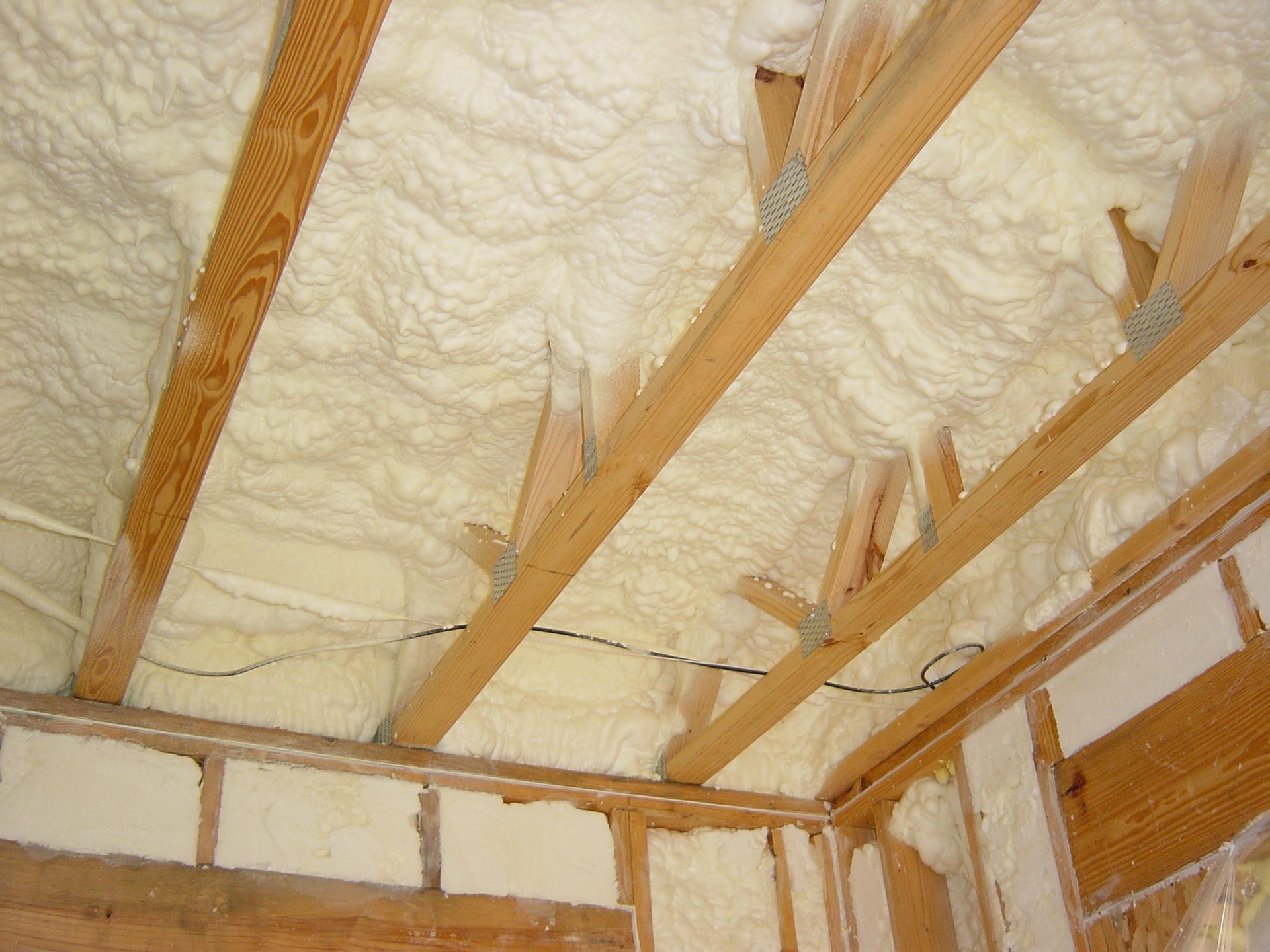
There are two primary categories of spray foam insulation: open cell and closed cell. The two types are differentiated by their material densities and their resulting variations in performance characteristics. Sometimes it is more ideal to use an open cell variety and other times the opposite is true. Because of that, density should always be considered when selecting spray foam for your commercial application.
All spray foam insulations provide thermal insulation and air barrier capabilities. Closed-cell spray foam insulations extend that further by functioning as a one-product solution for thermal, air and moisture control in the building envelope.
Open Cell Spray Foam Insulation
Open-cell spray foams have an open-cell structure and are lower-density options, with densities of approximately 0.5 to 1.4 pounds per cubic foot (8 to 22 kg/m3). Their density makes them more flexible, or spongy feeling to the touch, than their closed-cell counterparts.
Open cell foams enhance the structure’s energy efficiency. Escape of conditioned air from the interior structure (such as when indoor air was heated during cold months or cooled during warm months) is reduced, as is the energy consumption required to re-heat or re-cool the air in the structure.
One capability specific to open cell spray foams is sound attenuation. If there is loud noise outside, it is much less likely to be heard indoors when the insulation is installed in the building’s enclosure. Likewise, noise will be less detectable in the adjacent room on the other side of the partition wall, when the foam is installed in that interior wall.
Open cell foams also offer higher vapor permeability; they more freely release any vapor they absorb. This makes them much more suitable to interior applications including in interior walls and ceilings where water exposure risk is low, as well as in warmer climates where vapor barriers are not required.
A New Jersey office designed by Gensler, featuring a NanaWall HSW60 single-track system | Photography by Garrett Rowland Photography

The office of an Omaha financial institution designed by Alley Poyner Macchietto Architecture, featuring a Generation 4 acoustical, folding glass wall system.

Caption Goes Here
Caption Goes Here
Caption Goes Here
Open Cell Spray Foam Insulation
Open cell spray foams have an open cell structure and are lower density options at approximately 0.5 to 1.4-pound per cubic foot (8 to 22 kg/m3). Their density makes them more flexible, or spongy feeling to the touch, than their closed cell counterparts.
Open cell foams enhance the structure’s energy efficiency. Escape of conditioned air from the interior structure (such as when indoor air was heated during cold months or cooled during warm months) is reduced, as is the energy consumption required to re-heat or re-cool the air in the structure.
One capability specific to open cell spray foams is sound attenuation. If there is loud noise outside, it is much less likely to be heard indoors when the insulation is installed in the building’s enclosure. Likewise, noise will be less detectable in the adjacent room on the other side of the partition wall, when the foam is installed in that interior wall.
Open cell foams also offer higher vapor permeability; they more freely release any vapor they absorb. This makes them much more suitable to interior applications including in interior walls and ceilings where water exposure risk is low, as well as in warmer climates where vapor barriers are not required.
Closed Cell Spray Foam Insulation
Closed cell spray foam insulations are medium density options, typically measured at a range of 1.5 to 2.5 pounds per cubic foot (24 to 37 kg/m3) and their cell structure is closed. They feel significantly more rigid to the touch than open cell options. These physical attributes help them achieve a higher R-value per inch (or RSI value per mm) than open cell foams. The greater the insulation’s R-value (or RSI value), the measurement of an insulation’s resistance to conductive heat flow, the greater the thermal insulation performance.
The advised R-value (or RSI value), or amount of insulation needed to be applied in any given structure depends on the climate zone, capabilities of the HVAC system, and location in the structure where the insulation will be installed. The International Energy Conservation Code, or IECC, provides a map of climate zones by U.S. counties and territories with designations for each. It also offers product rating, marking and installation requirements for insulation (and other materials).
Closed-cell spray foam insulation is ideal for use as continuous insulation to reduce or eliminate thermal bridging. It can be used in interior and exterior applications, replacing commonly utilized rigid XPS, mineral wool and PIR foam boards. It offers low water absorption and mold resistance (demonstrated with ASTM C1338). Closed-cell spray foam excels as a water-resistant barrier on exterior applications and is tested in accordance with ASTM E2357 with a pressure up to 300 Pa for Air Barrier Assemblies, which includes the ASTM E331 (AC71) Water Penetration Testing. The result was no leakage through the spray foam.
Flood Resistance is a cornerstone of closed-cell spray foam insulation. FEMA rates it a Class 5 material, the highest product classification indicating strong resistance to floodwater damage, specifically when the material is applied in walls, ceilings and floors. Class 5 materials do not require special waterproofing protection, can survive wetting and drying, and may be cleaned after a flood to free them of most harmful pollutants. The FEMA Class 5 rating applies when closed-cell spray foam is installed as cavity or continuous insulation. The material is the only cavity insulation approved by FEMA with the highest floodwater resistance. When applied under slab as insulation, closed-cell spray foam is also flood resistant.
Most closed-cell spray foam insulations installed at a thickness of one inch (25.4 mm) meet Class II vapor requirements for colder climates, removing the need for an additional vapor barrier when Class II is required.
Closed-cell spray foam is also ideal in radon prevention. A naturally occurring radioactive gas that occurs when uranium in soil and rocks breaks down, radon can accumulate in buildings and homes, especially in basements and on ground levels, if it seeps into the structure. This can be problematic because radon is also a leading cause of lung cancer in non-smokers. Closed cell spray foam insulation can be used to prevent the gas from entering the structure at common points of entry in a seven step process that includes: subfloor preparation, installation of a depressurization pipe, installation of water drains, installing closed cell spray foam insulation to act as air barrier, sealing joints with the spray foam, sealing all openings and penetrations with the spray foam, and installing a sealed lid on sumps.
Closed-cell spray polyurethane foam insulation also provides structural strength and wind resistance. It glues the assembly together, reducing potential for movement, adding approximate tensile strength in the range of 15 psi to 25 psi (103 to 172 kPa). Installed in above-grade walls, the material improves wind resistance. The degree of hardening primarily depends on the initial strength of the structure. As a comparison, an I-beam modular constructed metal building with a 22-gauge metal panel will benefit much less from an interior application of closed cell spray foam than a post-frame constructed building with 29-gauge corrugated metal panels.
In 1992, 1996 and 2007, the Spray Polyurethane Foam Alliance completed racking performance tests at Architectural Testing, Inc. in Pennsylvania. The testing demonstrated that medium-density closed-cell spray foam installed at 2.0 pounds per cubic foot (32 kg/m3) increases racking strength by 70 to 200 percent in wall assemblies sheathed with oriented strand board (OSB), plywood, gypsum wallboard, vinyl siding and polyiso board. The research also proved closed cell SPF improved rack and shear strength in wood and metal construction. Installed spray foam also increases the strength of weaker variety substrates, including gypsum drywall, vinyl siding and polyiso foam insulation to a larger degree than stronger substrates such as OSB and plywood. Special wind resistance bracing is also not required to strengthen when applying the material in walls.
Finally, because of its sealing capabilities, closed cell spray foam insulation reduces the number of pests, pollutants and allergens able to enter the structure. It also acts as secondary water barrier, protecting the structure and its users from mold and mildew formation.
In closing, when choosing a spray polyurethane foam insulation, review the performance characteristics of open and closed cell options against the project’s building envelope goals, climate and weather considerations, and budget. Some spray foam insulation applications can reduce the number of other materials needed in construction. The ideal variety for the structure can be found among the range of available options.
Images courtesy of Huntsman Building Solutions.
Maxime Duzyk is senior global director of building science and engineering for Huntsman Building Solutions, a global leader in spray polyurethane foam solutions. To contact Maxime, write mduzyk@huntsmanbuilds.com.