A Minneapolis ceiling design at an American Indian Center incorporates elements of native culture and quiets ceremonial space. By Eric Herr
Circular Ceiling Design Ceremony
xxxxx. xxx
xxxxx
xxxxxxxxx
xxxxxxxxxxxxxxx By xxxxxxxx
h2 - xxxx
h3 - xxxx
H1 headline
When designing the interior of the new rotunda, a circular space inside the recently renovated Minneapolis American Indian Center, the architects from Cuningham understood the importance of incorporating circles into the design.
“Circles are very important within the Indian community,” explains Eric Lagerquist, associate principal, Cuningham, Minneapolis. “The medicine wheel and the drum circle are important elements of Native culture.”
These two concepts figure prominently in the ceiling design for the 1,906 square foot room which serves as a ceremonial space within the building. The space alludes to the medicine wheel and its four directions while aesthetically having some representation of the inside of the drum,” says Lagerquist. “It’s a little bit of the drum circle and a little bit of the drum itself.”
While the design team originally wanted the ceiling to be made from wood, they learned that a wood ceiling would not meet the acoustic requirements of the space. “We were looking for an affordable, highly effective ceiling material that would serve as an acoustic dampener for the space,” he explains. “Because it’s a gathering space, it has a certain acoustic reverberation requirement – or maximum noise level – that must be met so we had to be sure we were addressing that.”
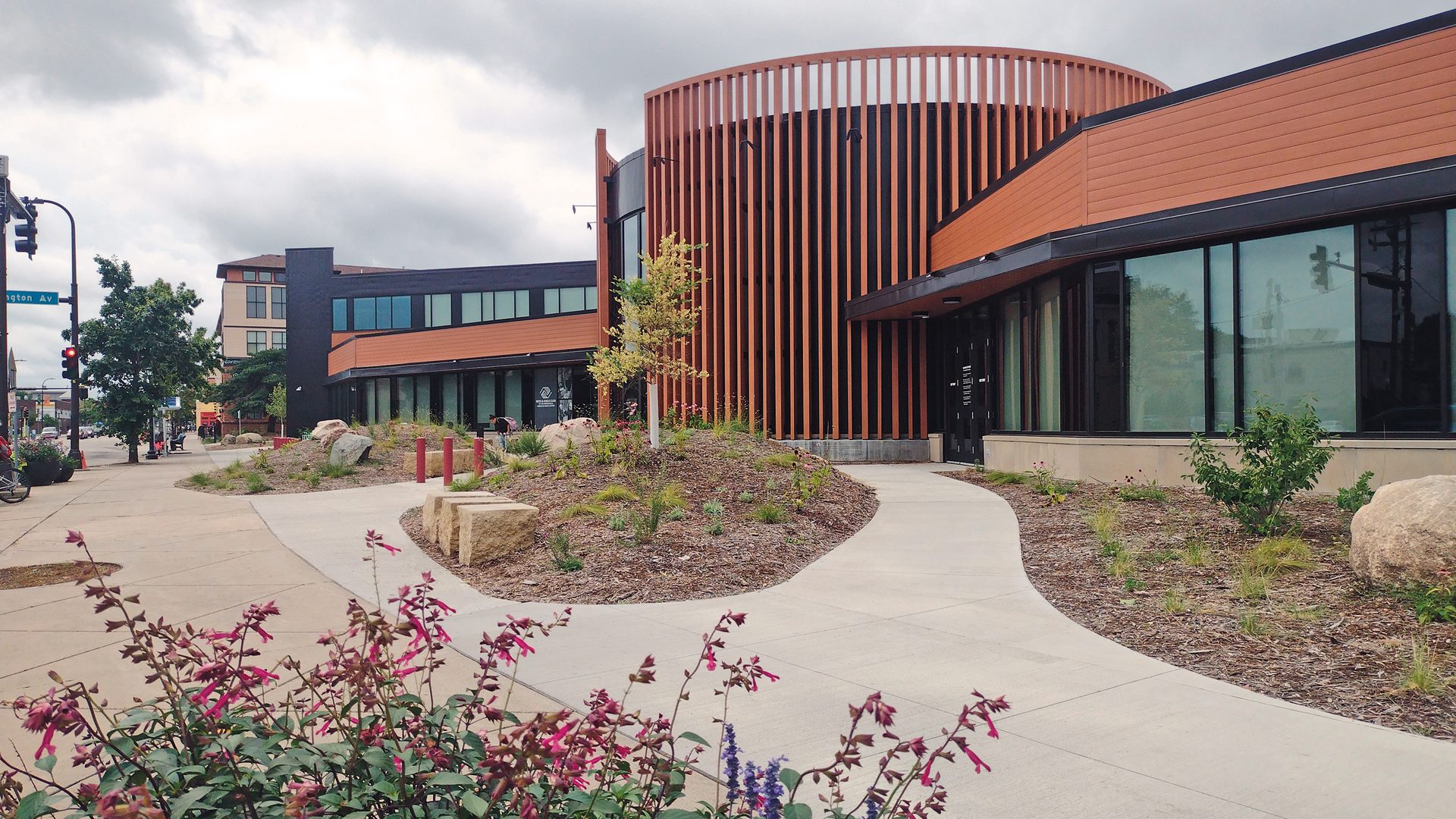
The exterior of the recently renovated Minneapolis American Indian Center shows what the rotunda looks like from the outside.
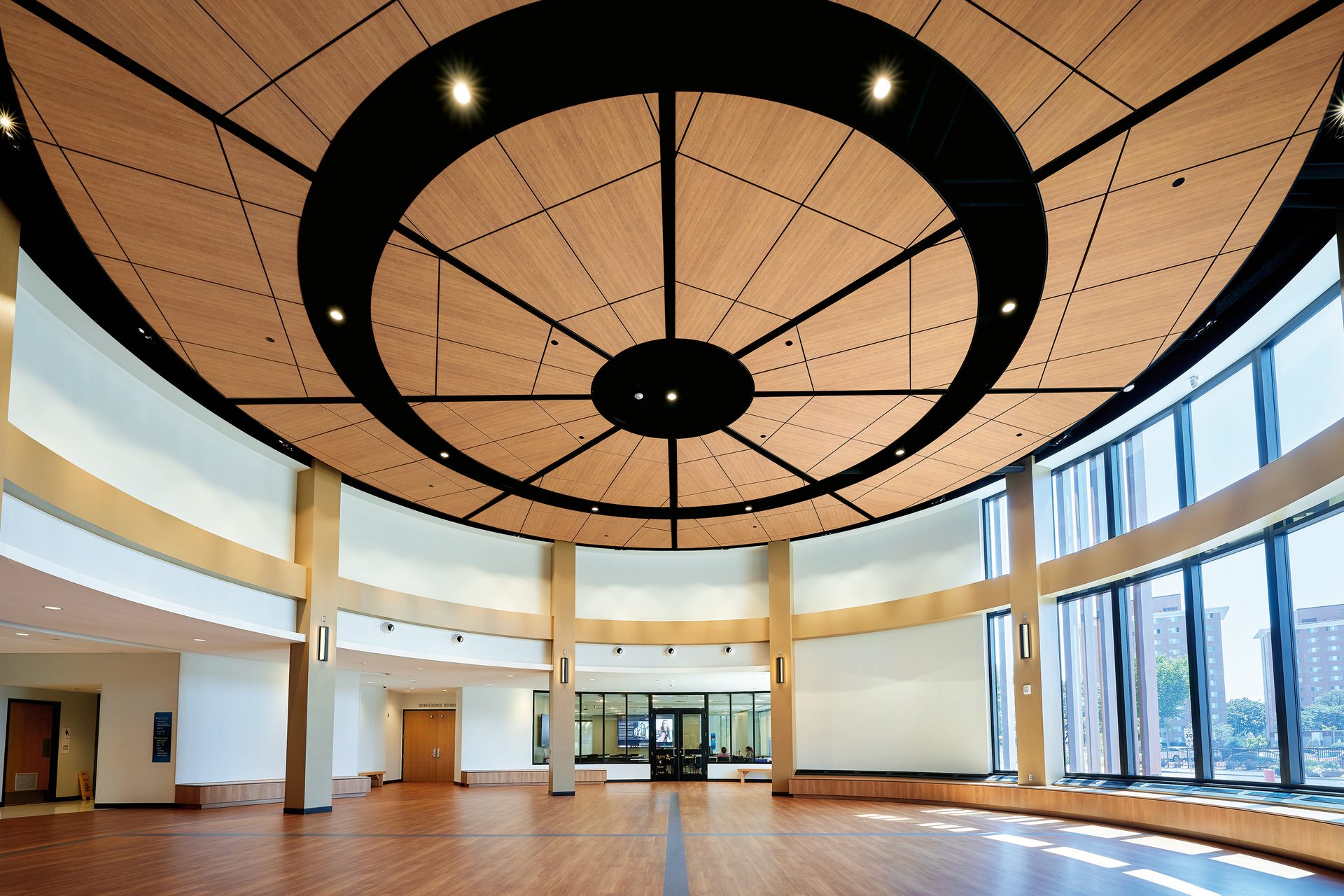
The circular ceiling suspended above the rotunda at the recently renovated Minneapolis American Indian Center reflects the importance of circles in Indian life.
Wood-look Ceiling Provides Superior Sound Absorption
While finalizing the design, the architects were introduced to Lyra PB Wood-Look ceiling panels, a product that provides the natural beauty of wood while absorbing up to 95 percent of the noise in the space. “In addition to addressing the acoustics, there was a cost savings over real wood,” said Lagerquist, “and the Bourbon Cherry finish that we chose for the panels aligned with the color of the Western Red Cedar we already had in the building.”
Made with a plant-based binder, Lyra PB panels are also part of the Armstrong Sustain portfolio, meaning they meet the most stringent industry sustainability standards today. “This helps us move toward the guidelines for state-funded projects like the Minneapolis American Indian Center that we build more sustainable buildings,” he adds.
The circular design creates the illusion of eight wedge pieces extending out from the center of the ceiling. The design was achieved by suspending 16 ceiling clouds, which form the inner and outer circles of the design, from the plenum. The plenum is painted black and has suspended pendant lights flush with the level of the ceiling clouds, creating an illusion of a floating ceiling.
Each ceiling cloud was created using 4-feet-by-4-feet panels field cut to fit the custom design. The panels are installed in a black 9/16-inch Exposed Tee grid system, which was field cut to accommodate the design of the clouds. Black 4-feet Axiom straight and curved perimeter trim encloses the outer edges of each ceiling cloud.
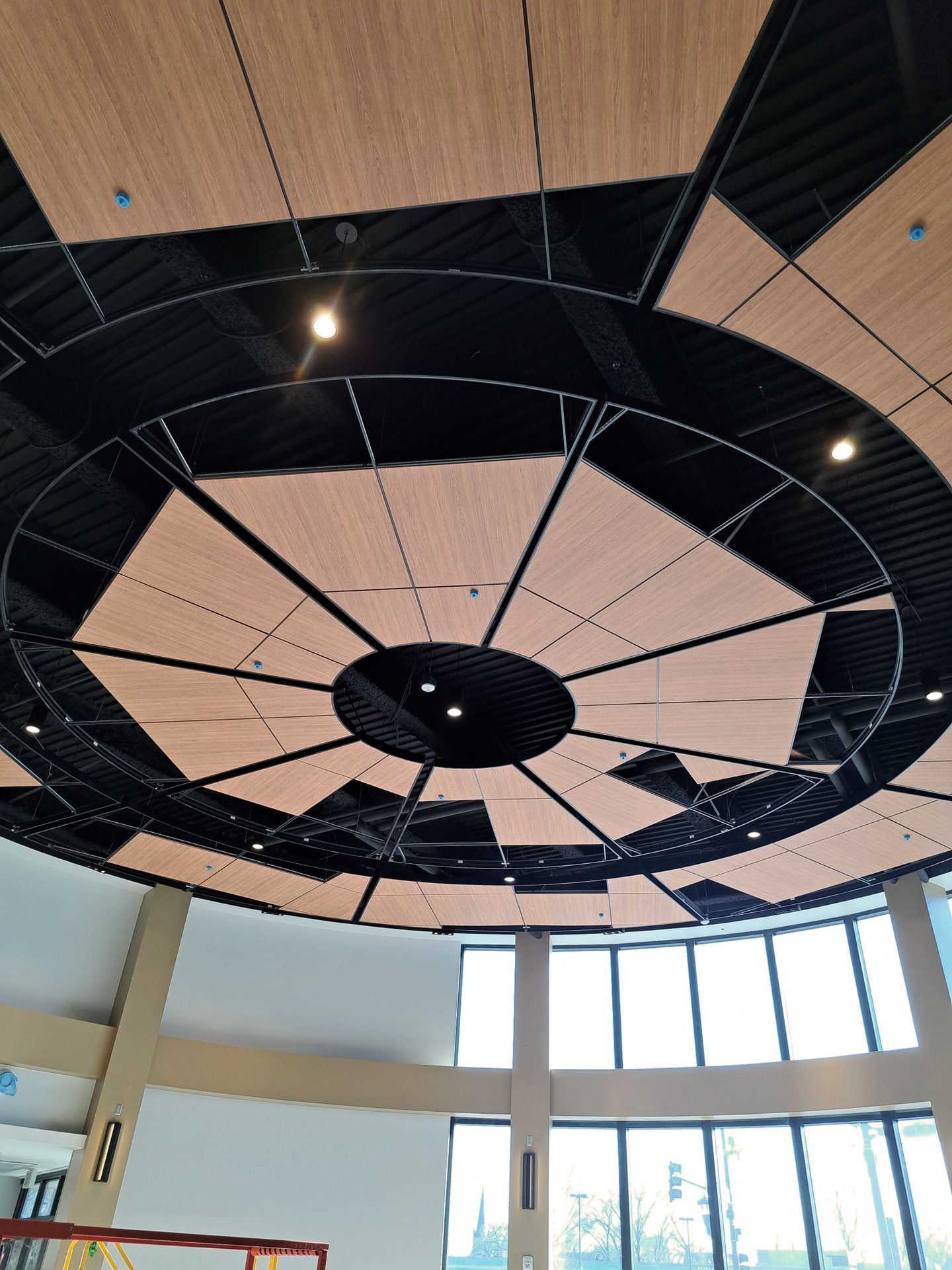
Construction of the circular ceiling in progress at the recently renovated Minneapolis American Indian Center.
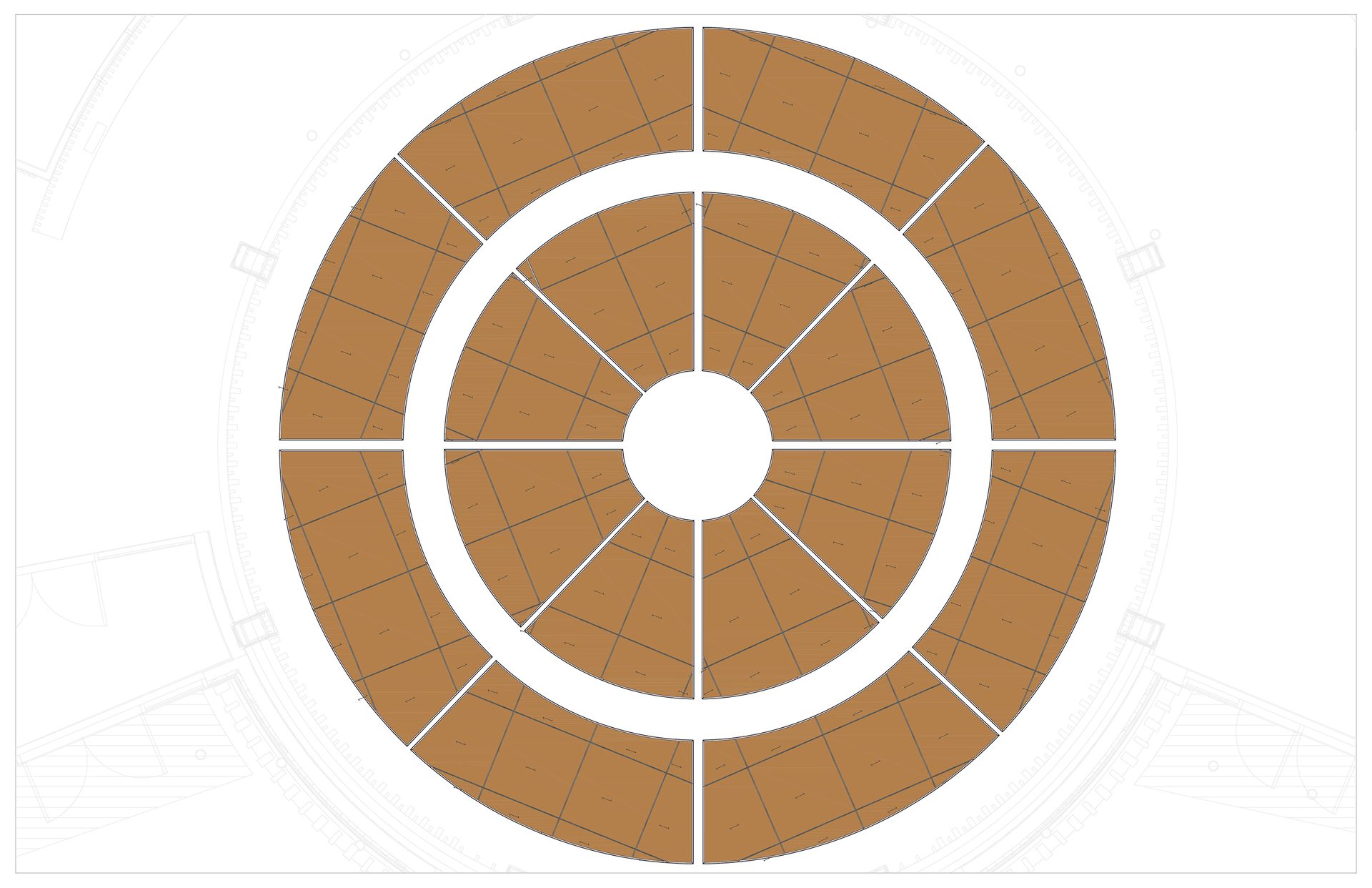
The complimentary Armstrong ProjectWorks Design & PreConstruction Service provided the ceiling contractor with a drawing package, which included detailed layouts of the panels, suspension system, hardware and trim. The RCP layout shown here is one element of a materials drawing package helping to ensure smooth, accurate installation.
Manufacturer Support Eases Installation of Complex Design
The complexity of the design prompted project manager TJ Rokke of Architectural Sales of Minnesota to reach out to the manufacturer’s Design and Pre-Construction Service for guidance with the installation. In addition to a drawing package, which included detailed layouts of the panels, suspension system, hardware, and trim, ProjectWorks provided the Armstrong manufacturing team with a detailed trim schedule showing the exact length, radius, and miter of every Axiom trim piece in the project. The trim was then pre-cut, pre-mitered, pre-curved, and shipped to the job site.
Axiom trim pieces, which form the outer edges of the ceiling clouds, were laid out on the floor, creating templates of both a smaller cloud from the inner circle and a larger cloud from the outer circle. “(The installation team) could lay the clouds out on the floor because the Axiom trim was all pre-cut in the factory,” explains Rokke. “These templates gave the installers the dimensions they needed to cut all the main runners and cross tees on the ground. They didn’t need to cut anything in the air.”
Working from scissor-lifts 20 feet above the floor, the team suspended the grid system from the deck, attached the Axiom trim to the grid, and installed the ceiling panels, which were field cut to fit the shapes of the clouds.
“This is a high-profile design,” says Rokke. “These are not your standard square or rectangular ceiling panels. Measuring and cutting all the angles takes time in the field, but with the Axiom trim being cut to size in advance by the manufacturer, that saved a lot of time and helped make sure that the ceiling clouds in the inner circle and the ceiling clouds in the outer circle were the same size.”
A Lightweight Alternative to Real Wood
The wood-look acoustical ceiling turned out to be a good alternative to the real wood ceiling the design team originally considered, says Rokke. “Most people don’t know that it’s not real wood because it’s so high up in the air,” he explained. “It’s a very lightweight fiberglass panel compared to a very heavy real wood panel. It also makes the labor side of it a lot easier. One worker can manage a lightweight acoustical ceiling panel whereas it might take two workers to manage a real wood panel.”
Because the rotunda is a ceremonial space where the Native American community comes to celebrate its rich cultural heritage with powwows and other events, the ceiling needed to be able to effectively absorb sound and improve speech intelligibility.
With more than 3,000 people in the building on Opening Day, the circular Lyra ceiling proved that it could provide superior sound absorption. “The space was full and acoustically it was very comfortable,” said Lagerquist. “We weren’t hearing a lot of reverberation, and you were able to talk intelligently to the person next to you.”
(The circular ceiling inside the rotunda at the Minneapolis American Indian Center is the winner of the 2025 CISCA Construction Excellence Award.)
Images courtesy of Armstrong World Ind.
Eric Herr, senior manager of sales and operations, ProjectWorks, Armstrong World Industries. Herr leverages nearly 25 years of experience in distribution and the construction industry to ensure customers can easily design, bid, order, and build with Armstrong products. As a ProjectWorks leader, he focuses on customer-centric solutions that facilitate stronger relationships between designers and contractors, efficient and accurate installation, and beautiful results.