Expanded metal ceilings combine strength, visual flexibility, and sustainability, giving architects and designers a high-performance material that elevates both form and function across a wide range of applications. By Manuel E. Menchaca
Expanded Metal Ceilings: Strength That Beautifies
xxxxx. xxx
xxxxx
xxxxxxxxx
xxxxxxxxxxxxxxx By xxxxxxxx
h2 - xxxx
h3 - xxxx
H1 headline
Architects and designers shape environments that enhance quality of life, and material selection plays a critical role in achieving that goal. One material gaining increased attention for its balance of aesthetics, versatility, and performance is expanded metal. Also referred to as architectural or decorative mesh, expanded metal is valued for its uniform patterns, strength, and lightweight properties—making it an excellent choice for ceiling panel systems in projects of any scale.
Expanded metal is defined by its open-area composition, which allows it to conceal, decorate, provide shade, and promote ventilation without sacrificing strength. Once a design concept is established, designers must choose between traditional diamond-shaped openings or decorative patterns. With a wide range of pattern options available, expanded metal offers consistent uniformity while remaining strong and lightweight.
Before manufacturing, several key specifications must be determined to ensure panels meet design and performance requirements:
- Long Way and Short Way Openings (LWO & SWO): Define opening size in the long and short directions
- Open Area Percentage (if required): Indicates how much of the sheet is open space after expansion
- Strand Width and Pitch: Determines strand thickness and angle
- Raised or Flattened Strands: Raised strands create visual depth, while flattened strands provide a smooth, level surface
- Panel Length and Width: Final dimensions after post-expansion shearing
- Random or Bond Shearing: Determines whether strand intersections have jagged or flat edges
- Finish Options: Mill finish, paint or powder coating
- Metal Type and Thickness: Aluminum offers lightness, steel provides strength, and copper delivers bold visual impact
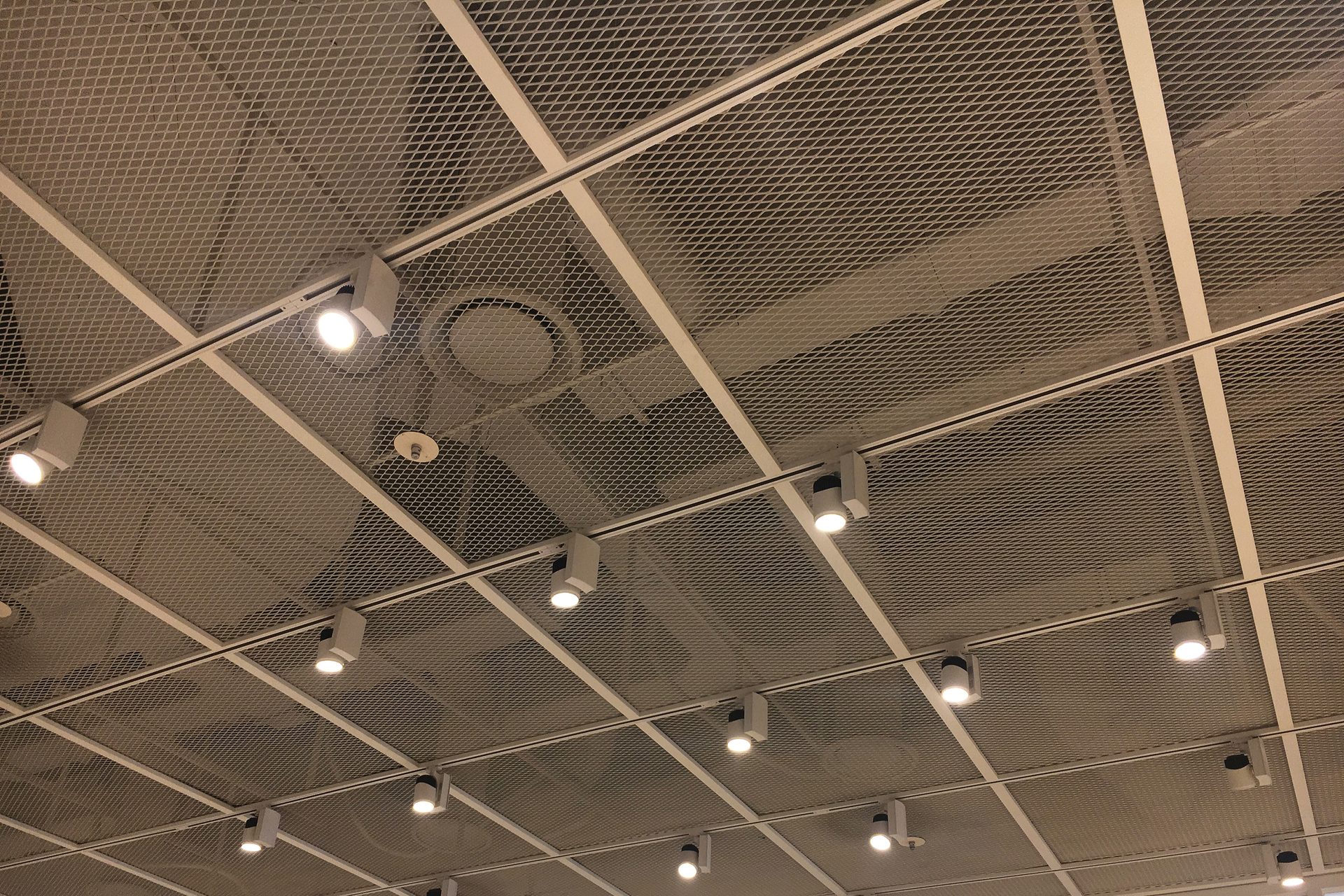
A New Jersey office designed by Gensler, featuring a NanaWall HSW60 single-track system | Photography by Garrett Rowland Photography
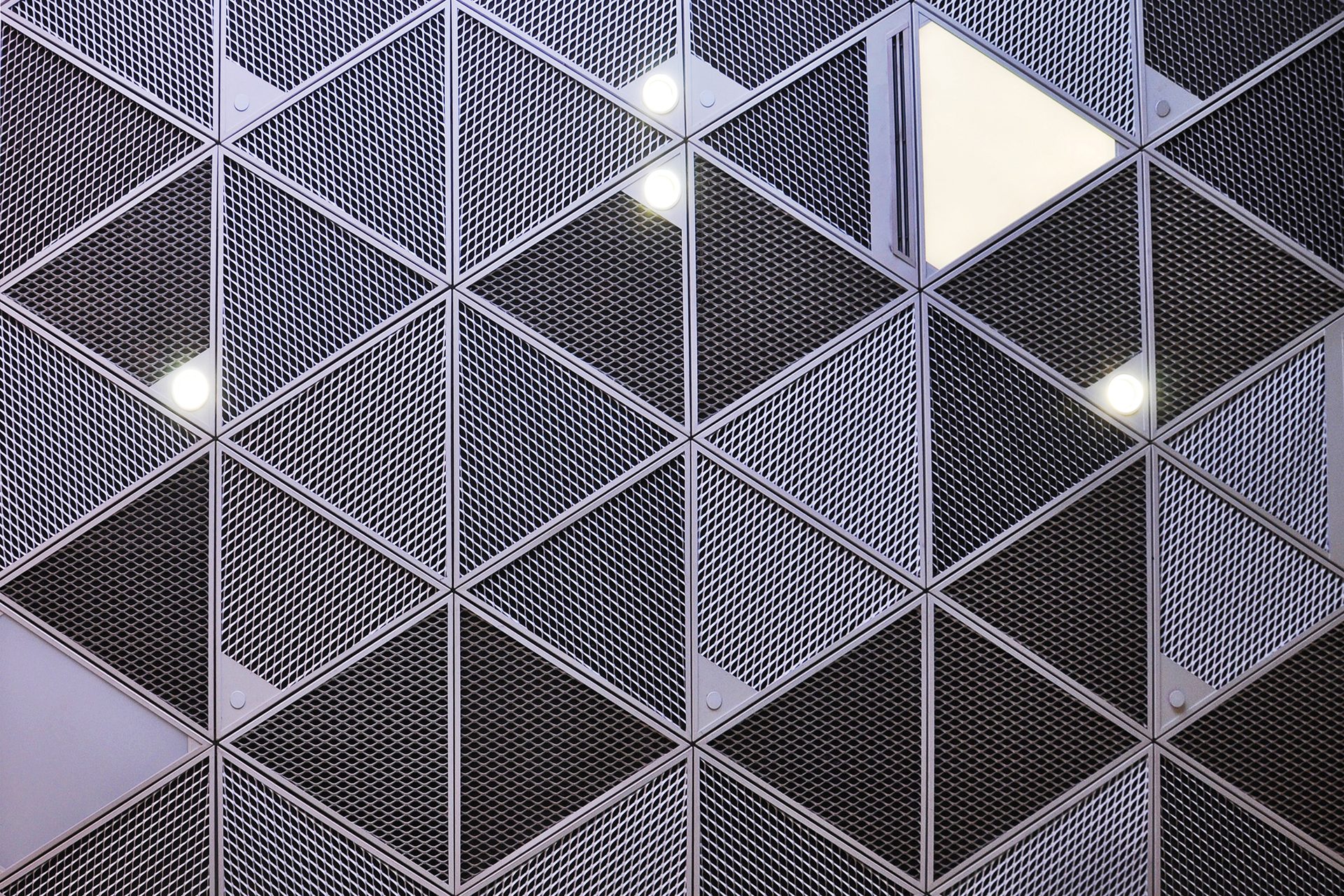
The office of an Omaha financial institution designed by Alley Poyner Macchietto Architecture, featuring a Generation 4 acoustical, folding glass wall system.
Opening size and strand style directly influence how open or concealed a ceiling appears. Larger openings create a sense of openness and reveal the plenum above, while smaller openings offer greater concealment. When panels are installed near lighting or HVAC components, larger openings can also improve airflow and illumination.
Strand selection further refines the design. Raised strands interrupt sightlines even in wider patterns, while flattened strands allow greater visibility. Wider strands increase coverage and convey solidity. Together, these variables define the ceiling’s visual and functional character, making careful planning essential.
Finishes and Color: Setting the Mood
Finish selection plays a significant role in the overall aesthetic. A mill finish delivers a clean, industrial look, particularly striking when copper is used for its warmth and evolving patina. Painted panels allow for seamless integration with surrounding finishes or can be color-matched to the substructure for visual continuity.
Powder coating, while a higher upfront investment, offers superior durability. One critical rule applies: expand first, coat second. Expanding metal after painting or powder coating exposes uncoated edges or cracks the finish—an issue that cannot be repaired with powder coating. For best results, panels should be finished at the plant after expansion, with onsite painting limited to touch-ups.
Installation Options: Bringing the Vision to Life
Expanded metal ceiling panels can be installed using a variety of methods. For straightforward installations, panels may be set into standard dropped-ceiling or acoustic tile frames. Panels are cut to size at the plant and simply laid into place onsite.
For areas requiring frequent access, swing-open framed panels provide easy maintenance. Fire sprinkler placement is another important consideration. Sprinklers are typically installed below the panels; if panels are placed beneath sprinklers, fire codes require minimum opening sizes or open-area percentages to ensure proper water dispersion.
For a near-seamless aesthetic, panels can be mounted end-to-end on parallel rails. Panels are formed with all four sides bent upward, creating a box that attaches to the rail system and conceals the frame above. Spacing between panels can double as channels for lighting or sprinkler systems, and longer panels help create the appearance of a continuous surface.
Expanded metal panels are not limited to flat or rectangular forms. They can be fabricated into three-dimensional shapes or suspended vertically to define spaces, influence lighting, or serve as signage elements. Collaboration with an experienced manufacturer is key to developing custom mounting solutions.
xxxxxxxxxxxx
Integrated Vent Solutions
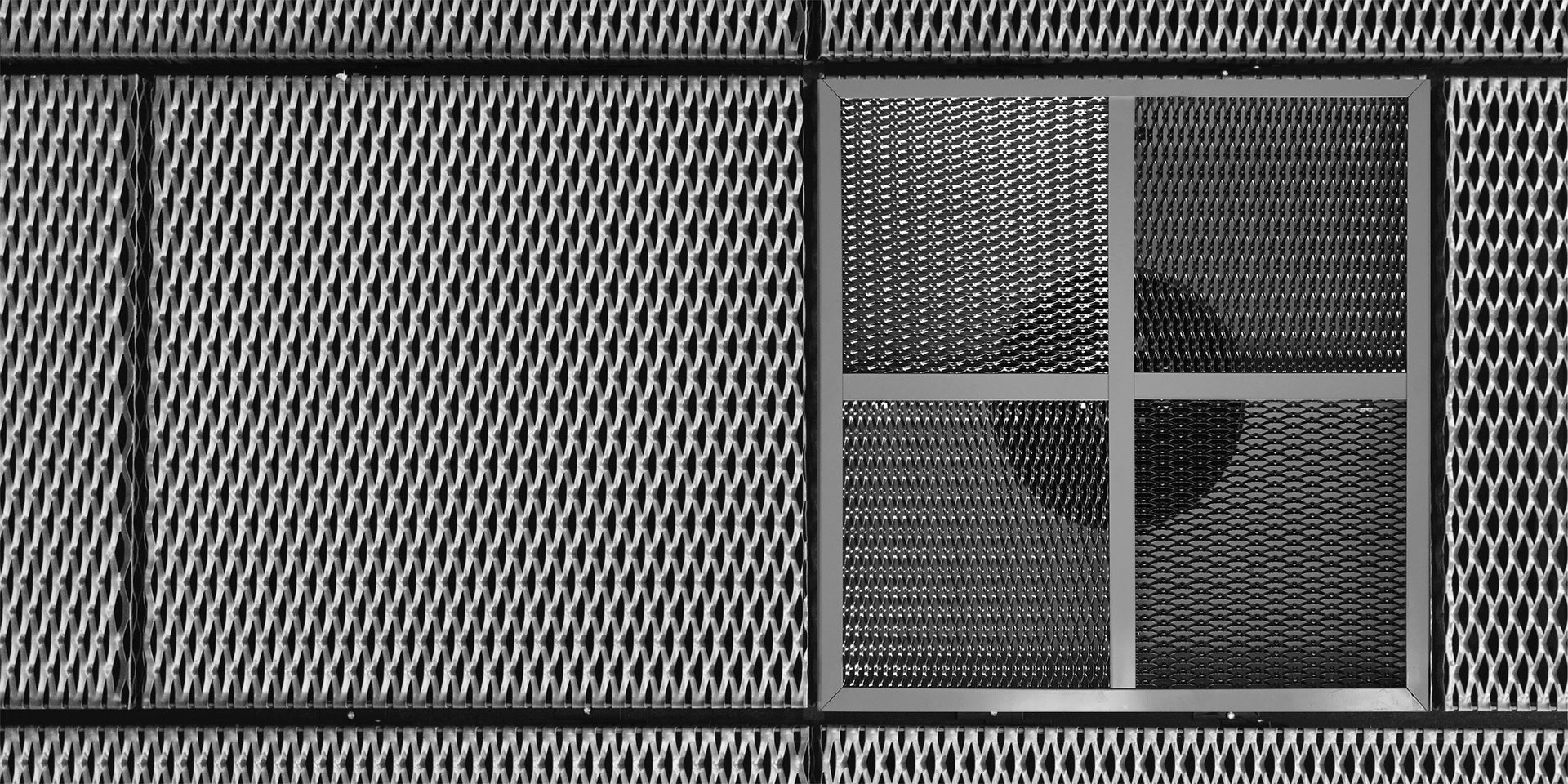
For designers seeking visual continuity, Wallner Expac’s patented four-way ceiling diffuser grilles (U.S. Patents No. D921174 and No. D921175) allow ceiling vents to match expanded metal panels. The system enables cost-effective installation by replacing only the housing grille rather than the entire vent unit, resulting in a clean, uniform appearance.
Environmental Advantages: A Sustainable Choice
Expanded metal is inherently sustainable and 100 percent recyclable. Raw materials often contain 20 to 35 percent recycled content, with some suppliers reaching 40 percent or more. High-recycled-content steel can contribute toward LEED MR Credit 4 under USGBC guidelines.
The manufacturing process itself is highly efficient. Expanded metal is slit and stretched rather than punched, producing minimal waste and no scrap parts. Yields commonly reach 3:1, meaning significantly more finished material is produced from the original raw metal. The result is a strong, lightweight, single-sheet product with no welds or separation points.
Beyond Ceilings: Expanded Metal Applications
While widely used for ceilings, expanded metal is equally effective in facades, where it can influence lighting, shading, ventilation, and privacy while reducing solar heat gain. Additional applications include fencing, gates, railings, stairs, awnings, furniture, cabinet inserts, shelving, and infill panels. Its open pattern allows for quick drainage outdoors, and protective coatings extend service life.
A Material That Delivers
Whether used in ceiling systems or across a broader range of architectural applications, expanded metal offers exceptional design flexibility, structural performance, and environmental benefits. Its efficient manufacturing process and potential contribution to LEED certification make it a compelling choice for sustainable design.
Images courtesy of Wallner Expac.
Manuel E. Menchaca, MBA, is the senior marketing manager for Wallner Expac, a leading manufacturer of expanded metals for the architecture, HVAC filters, construction, and automotive, among others. With nearly 30 years of experience, he specializes in marketing strategy, professional writing, and graphics. For the past decade, he has driven marketing initiatives at Wallner Expac, following a successful career leading marketing teams across diverse sectors. Menchaca holds a bachelor’s degree from California State University, Fullerton, and an MBA in Marketing from the University of Redlands.