Why Water and Wall Assembly Simplicity Still Rules Modern Construction
Water governs every building decision, and when it comes to insulated wall claddings, simpler, proven systems like EIFS consistently outperform overly complex assemblies.
Albert Carrillo
STUCCO STOP
Water is king. It is an amazing thing: An absolute in maintaining life, all life. It can exist at the tiniest scale as a gas, become vapor, condense into liquid, freeze and expand, then reverse the entire process back into a gas. If you stop and think about it, the mere cycle of evaporation to rainfall inspires awe at its majesty; a design and performance characteristic beyond any human capability to create or replicate.
Water can also be mischievous. It seeks dry spots and attempts to saturate them. This is a law of thermodynamics that cannot be rewritten, modified, debated, or ignored. In our built environment, water is the first and foremost consideration in construction.
Water’s Negotiation With Stucco and EIFS
Water is stucco’s and EIFS’s best ally during mixing and application, then their greatest threat thereafter. There exists a negotiation of sorts: stucco and EIFS claddings welcome water during mixing and application, and after curing, allow water vapor to naturally permeate but they draw a firm line when liquid water attempts to infiltrate. It is a negotiation as old as man.
Over time, we created construction practices and rules (known as building codes) to protect the interiors of buildings from the water outside. For centuries, humanity has successfully evolved construction methods to meet the demands of style, size, and location. We know how to keep water out of our buildings.
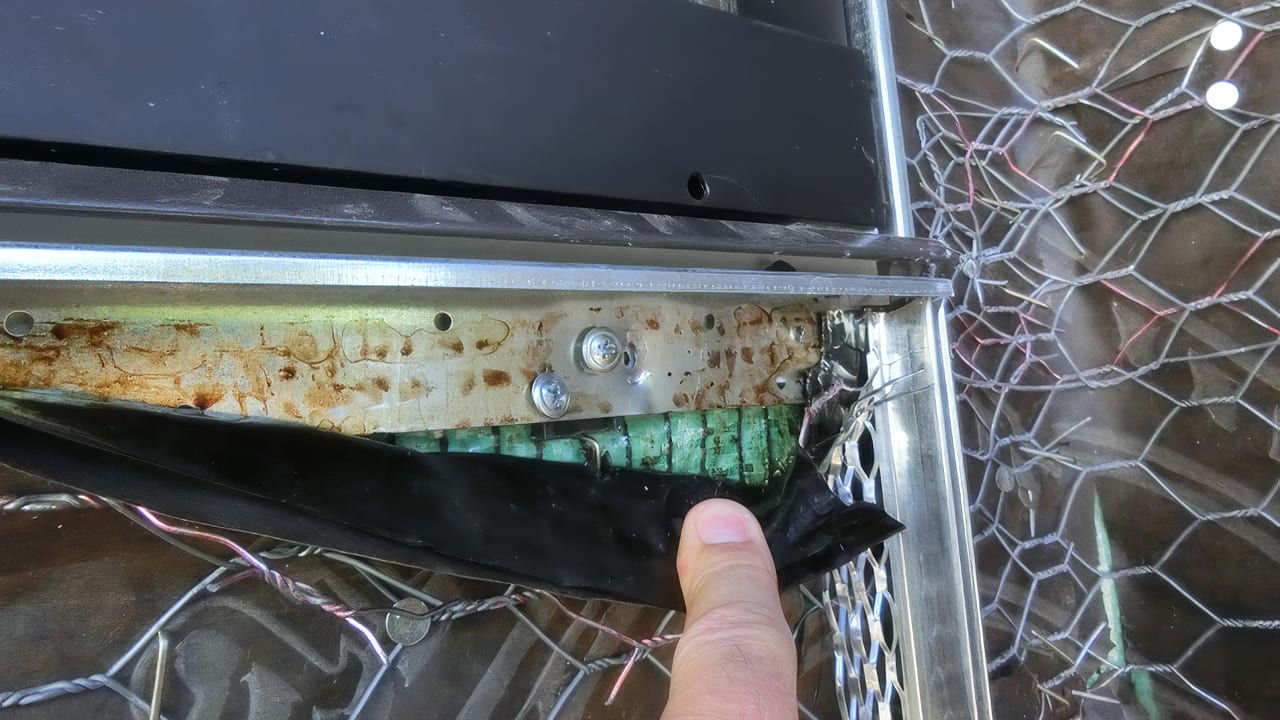
The installation of a drainage medium, a decorative black aluminum flashing, a peel-and-stick membrane and washer-head screws cause a misalignment between the control joint and the casing bead above it.
EIFS: A Proven System in a Tighter Building Era
Enter modern society’s desire to be more environmentally responsible toward our built environment: tighter buildings, greater energy efficiency, reduced energy use, and a lower carbon footprint. EIFS is the proven cladding that achieves this. It is an engineered weather barrier system that also insulates the building.
EIFS has a long, well-documented history of delivering a one-two performance punch unmatched, in my opinion, by any other cladding. Early on, EIFS incorporated an engineered drainage component to address the unfortunate reality of moisture intrusion. Keeping things simple, a continuous water-resistive barrier resides over the wall assembly, the EPS foam adhesive is oriented to allow water to egress, the EPS provides insulation, and the lamina serves as a weather barrier.
EIFS checks a lot of boxes: few components, simple installation, lower installation costs, a wide variety of finishes, and evergreen thermal performance. It’s the gift that keeps on giving.
Stucco’s Strength—and Where It Falters
By contrast, insulated stucco claddings present a very different picture. Traditional stucco, when not asked to insulate, has an excellent performance track record. It is durable, fire-resistant, and offers strong impact resistance. It has served as a cladding for centuries, dating back to biblical times, and remains affordable and relatively easy to install.
Apart from EIFS, there are two major distinctions: stucco is not a system but an assembly, and there are many component options within that assembly. All in all, stucco is an excellent cladding for keeping water out of a building.
Where stucco becomes a shadow of itself is when it is designed to function as an insulating cladding. In my former plastering years, we completed a fair amount of stucco-over-foam applications. We had custom accessories fabricated to accommodate foam thickness and spent considerable time wire-tying accessories to lath. With the many stucco component choices available, we were able to “engineer” insulated stucco assemblies.
Fast-forward to today’s construction climate, where “more is better” and water intrusion litigation looms large.
Insulated stucco assemblies are increasingly being referred to as “Frankenstein Walls,” a lighthearted term introduced by Mark Fowler in his Up Front column (Walls & Ceilings, January 2026). The phrase underscores the growing complexity of today’s mixed-component wall systems, many of which combine materials and techniques that have not yet been fully evaluated together as part of a unified assembly.
The Frankenstein Wall Problem
An insulated stucco assembly can look something like this: start with a liquid-applied WRB, then apply a sheet good (code requirement) over the liquid-applied coating. Openings are detailed with peel-and-stick or liquid-applied flashings that must lap and integrate perfectly with WRB layers. Stucco trims are installed over the WRB, followed by additional flashing membranes to maintain continuity.
Next comes the insulating foam layer, fastened through the foam, WRB layers, and into framing members at 7-inch intervals, as required by code. Finally, three layers of stucco are applied to achieve the code-mandated 7/8-inch thickness.
In cross-section, the accumulation of materials at stucco accessory locations creates areas where the stucco cannot be applied to the required thickness without forming a visible bump. These bumps are unavoidable, highly noticeable, and almost always unacceptable.
True to the Frankenstein Wall analogy, the variations continue to multiply: Z-girts, foam over stucco, multiple insulation types, accessories over or under foam, WRBs above or below insulation, peel-and-stick WRBs, waterproofing layers in lieu of WRBs, and layers of non-stucco protection. The options are endless, and a detail that looks perfect on paper can still fail in the field.
Water Always Wins, So Keep It Simple
We cannot change the laws of thermodynamics that govern water. Water doesn’t read building codes and cannot distinguish between wall cladding types. It has one directive: move from wet to dry.
That’s why I consistently promote a K.I.S.S. mentality toward construction. Simple is usually best. More is not better. And if something works, keep using it—until it doesn’t.
Image Credit: Steve Caldwell, Detect It LLC
Albert Carrillo was the CEO for the Western Wall & Ceiling Contractors Association and now serves as its senior adviser. He can be reached at albert@wwcca.org.